
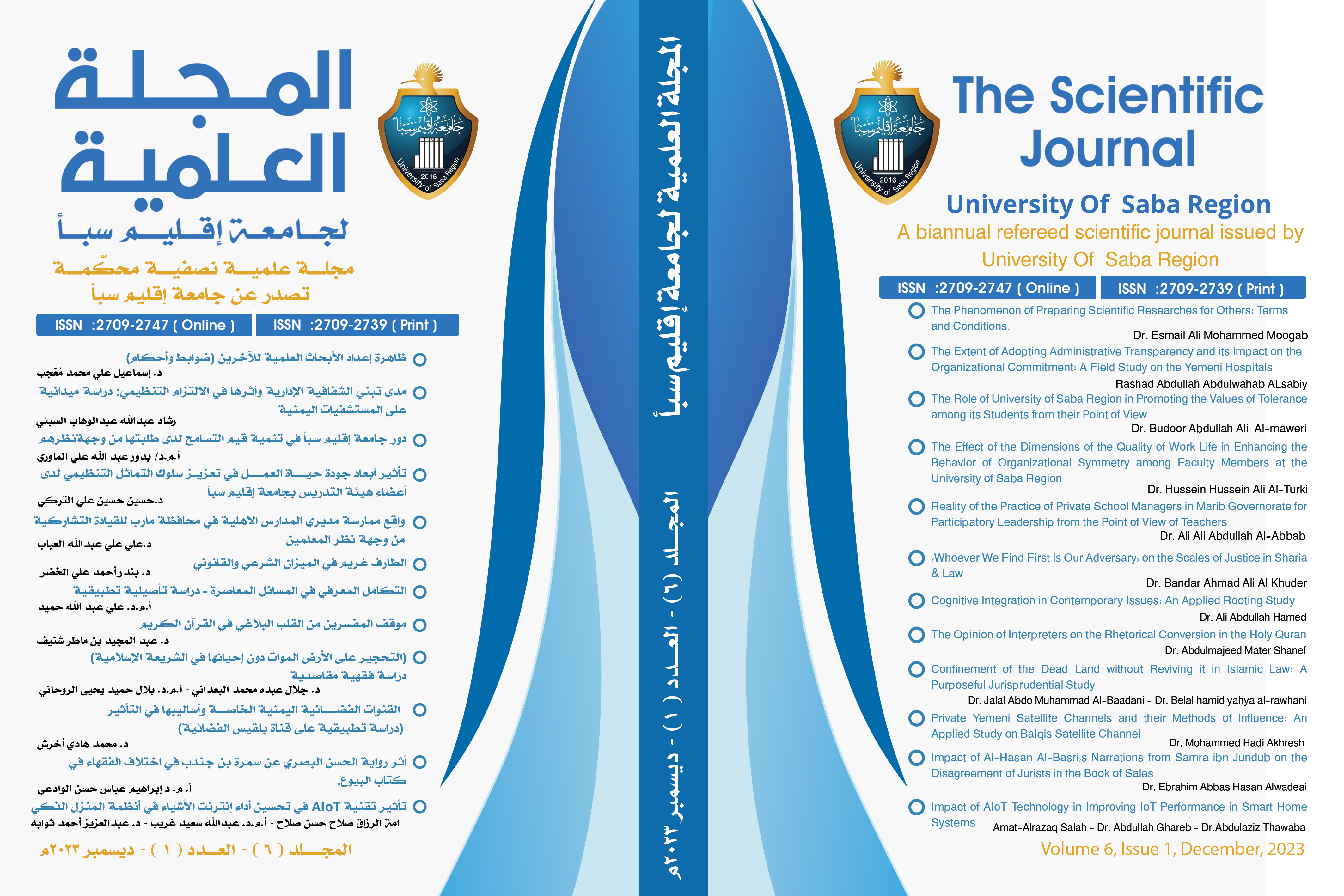
Cognitive Integration in Contemporary Issues: An Applied Rooting Study
DOI:
https://doi.org/10.54582/TSJ.2.2.69Keywords:
Cognitive, Integration, MattersAbstract
This study, entitled ‘Cognitive Integration in Contemporary Issues: an Applied Original Study’, is aimed to give a brief rooting of cognitive integration by outlining its concepts, significance, stages and conditions, with the presentation of models of its contemporary applications, through three sections: the first is concerned with the concept and significance, the second is about the stages and conditions, and the third is about the applications. The methodology used in this research is the inductive and descriptive methods. The study concludes with emphasis on the necessity of integrating science and knowledge in understanding religious texts, and applying them to emerging issues that have no explicit text in the Islamic law (Sharia) in order to achieve the interest of people in this life and in the hereafter. This integration goes through stages, starting from the perception of the incident, and ending with the consideration of its consequences, and it has conditions and controls such as those related to the conditions of the well-versed scholars, or related to understanding the issue, or the conditions for considering knowledge in understanding religious texts and purposes. Knowledge integration achieves a great deal of correctness in applying Sharia rulings to emerging issues.
Downloads
Published
How to Cite
Issue
Section
License
Copyright and Licensing
This journal publishes all scientific materials under the Creative Commons Attribution 4.0 International (CC BY 4.0) , license, which grants you the following permissions:
You are free to:
- Share — copy and redistribute the material in any medium or format for any purpose, even commercially.
- Adapt — remix, transform, and build upon the material for any purpose, even commercially.
- The licensor cannot revoke these freedoms as long as you follow the license terms.
Under the following terms:
- Attribution — You must give appropriate credit , provide a link to the license, and indicate if changes were made . You may do so in any reasonable manner, but not in any way that suggests the licensor endorses you or your use.
- No additional restrictions — You may not apply legal terms or technological measures that legally restrict others from doing anything the license permits.
Notices:
You do not have to comply with the license for elements of the material in the public domain or where your use is permitted by an applicable exception or limitation .
No warranties are given. The license may not give you all of the permissions necessary for your intended use. For example, other rights such as publicity, privacy, or moral rights may limit how you use the material.