
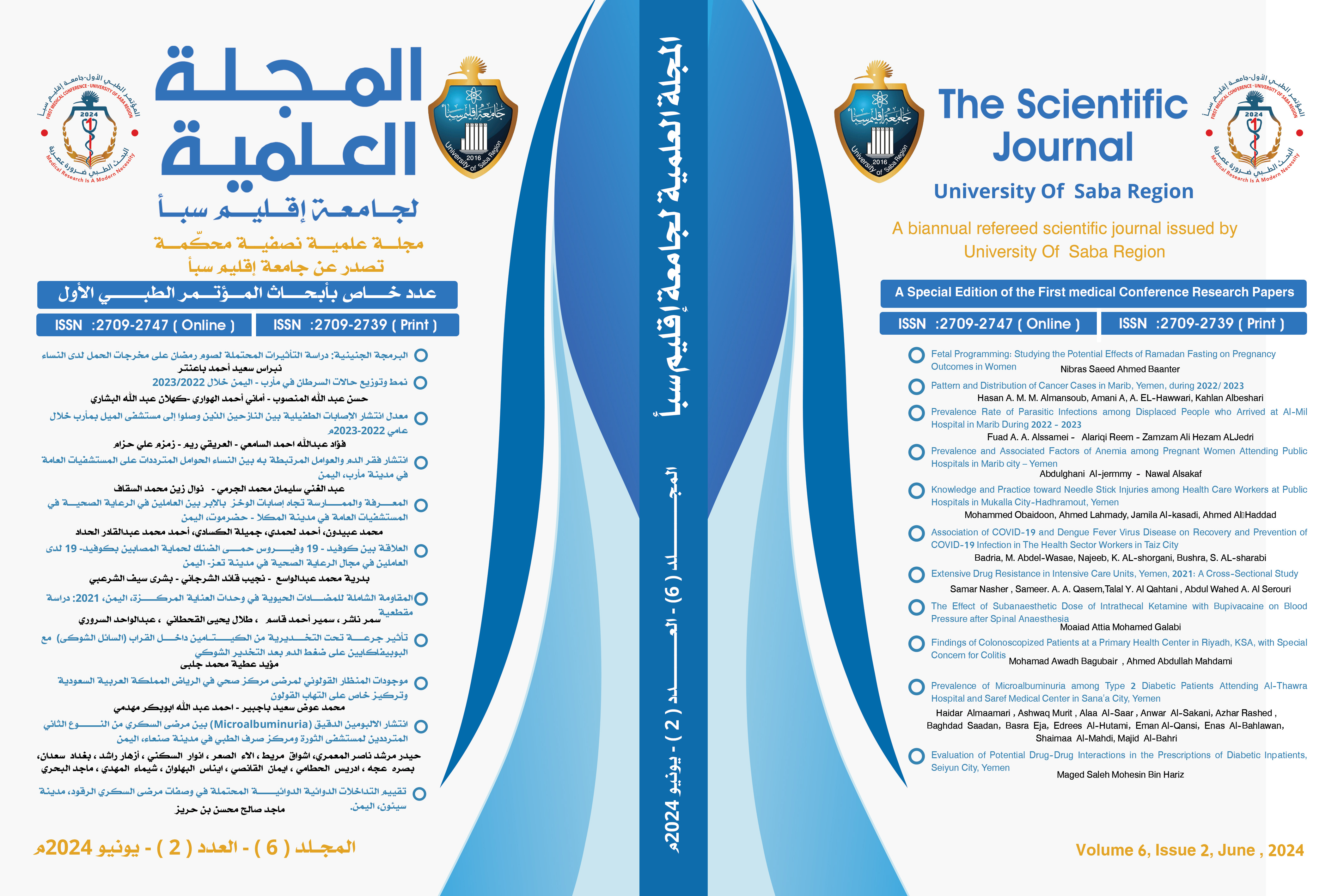
Knowledge and Practice toward Needle Stick Injuries among Health Care Workers at Public Hospitals in Mukalla City-Hadhramout, Yemen
DOI:
https://doi.org/10.54582/TSJ.2.2.79Keywords:
Needle stick injuries, knowledge, practice, healthcare workers, Mukalla, YemenAbstract
Background: Needle Stick Injuries (NSIs) are defined as accidental skin- penetrating stab wounds from a hollow-bore needle containing another person’s blood or body fluid. NSIs are one of the most potential hazards for health care workers. They pose a significant risk of occupational transmission of blood-borne pathogens.
Objectives: The aim of the study is to assess knowledge and practice toward needle stick injuries among health care workers (HCWs) at public hospitals in Mukalla city.
Methods: A descriptive cross-sectional study was conducted among health care workers at Ibn Sina General Hospital Authority and Mukalla Maternal and Childhood Hospital. A pre-tested, self-administered questionnaire was used for the data collection. Descriptive statistics were made to analyze the collected data using the Statistical Package for Social Sciences (SPSS) version 26.
Results: Most respondents, 194 (75.8%) aged between (21-31) years, males and females were almost equally distributed. Vast majority of HCWs 234 (91.4%) have a good knowledge regarding NSIs, while only 22 (8.6%) have a poor knowledge. Most of HCWs 237 (92.6%) have a poor practice toward NSIs, while only 19 (7.4%) have a good practice.
Conclusion: Majority of HCWs have a good knowledge, and poor practice toward NSIs. Most of them know that NSIs can be preventable. More than two thirds strongly agree that needles should be discarded immediately after use. Only less than one third use the one-hand method for recapping needles.
Downloads
Published
How to Cite
Issue
Section
License
Copyright and Licensing
This journal publishes all scientific materials under the Creative Commons Attribution 4.0 International (CC BY 4.0) , license, which grants you the following permissions:
You are free to:
- Share — copy and redistribute the material in any medium or format for any purpose, even commercially.
- Adapt — remix, transform, and build upon the material for any purpose, even commercially.
- The licensor cannot revoke these freedoms as long as you follow the license terms.
Under the following terms:
- Attribution — You must give appropriate credit , provide a link to the license, and indicate if changes were made . You may do so in any reasonable manner, but not in any way that suggests the licensor endorses you or your use.
- No additional restrictions — You may not apply legal terms or technological measures that legally restrict others from doing anything the license permits.
Notices:
You do not have to comply with the license for elements of the material in the public domain or where your use is permitted by an applicable exception or limitation .
No warranties are given. The license may not give you all of the permissions necessary for your intended use. For example, other rights such as publicity, privacy, or moral rights may limit how you use the material.