
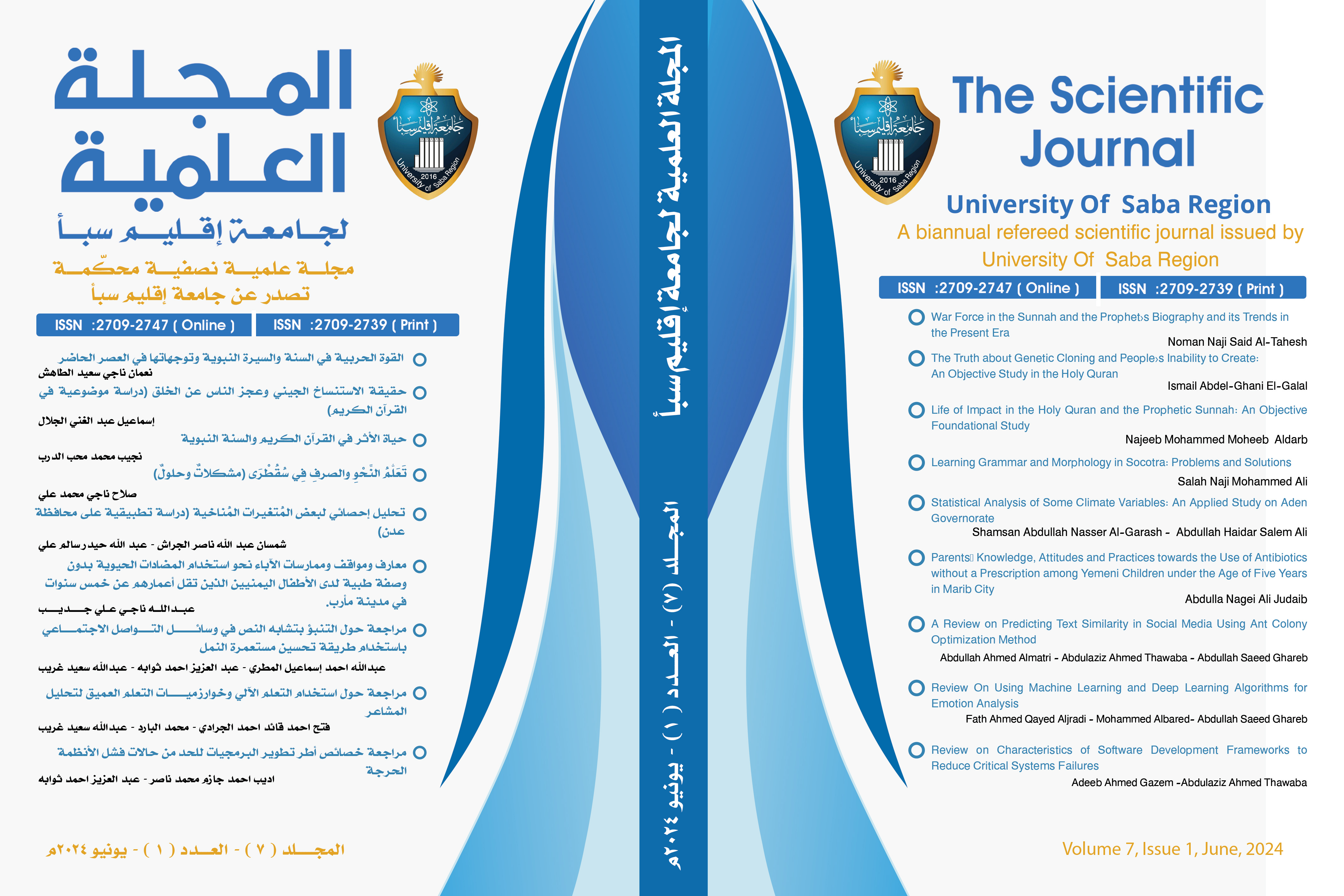
Learning Grammar and Morphology in Socotra: Problems and Solutions
DOI:
https://doi.org/10.54582/TSJ.2.2.89Keywords:
Socotri Language, Arabic Sounds, Morphological Tilting, Linguistic Stock, Grammar and MorphologyAbstract
Socotri language is one of the languages that has withstood the impact of Standard Arabic. It has its own characteristics and features, some of which pose obstacles and problems for students. This study aims to uncover those problems, such as the absence of certain Arabic sounds in Socotri, the morphological tilting towards yā’a and kasra, the fact that it is not a parsed language. These problems manifest when the student attempts to speak, read, and write Arabic, represented by the large number of spelling, morphological, and grammatical errors. This study attempts to describe these problems and seeks to provide solutions and treatments, and raises the issue to researchers. It consists of an introduction that includes the research problem, aims, questions, previous studies, methodology, limits, and a preamble discussing whether Socotri is a dialect or a language? As well as there are two sections: the first deals with phonological and morphological problems, and the other deals with grammatical problems and others. The findings of this research emphasize that Socotri is a language with a linguistic duality with Arabic, which causes pronunciation deviations, and the presence of sounds in Arabic that do not exist in Socotri is one of the reasons for the student to make mistakes. The study also comes to the result that the lack of stock of Arabic words and sentences, and poor writing and spelling are among the reasons for the student’s weakness in the rules of grammar and morphology. The research recommends studying the phonetic differences between Arabic and Socotri languages and collecting and studying common linguistic errors in Socotra,
Downloads
Published
How to Cite
Issue
Section
License
Copyright and Licensing
This journal publishes all scientific materials under the Creative Commons Attribution 4.0 International (CC BY 4.0) , license, which grants you the following permissions:
You are free to:
- Share — copy and redistribute the material in any medium or format for any purpose, even commercially.
- Adapt — remix, transform, and build upon the material for any purpose, even commercially.
- The licensor cannot revoke these freedoms as long as you follow the license terms.
Under the following terms:
- Attribution — You must give appropriate credit , provide a link to the license, and indicate if changes were made . You may do so in any reasonable manner, but not in any way that suggests the licensor endorses you or your use.
- No additional restrictions — You may not apply legal terms or technological measures that legally restrict others from doing anything the license permits.
Notices:
You do not have to comply with the license for elements of the material in the public domain or where your use is permitted by an applicable exception or limitation .
No warranties are given. The license may not give you all of the permissions necessary for your intended use. For example, other rights such as publicity, privacy, or moral rights may limit how you use the material.