
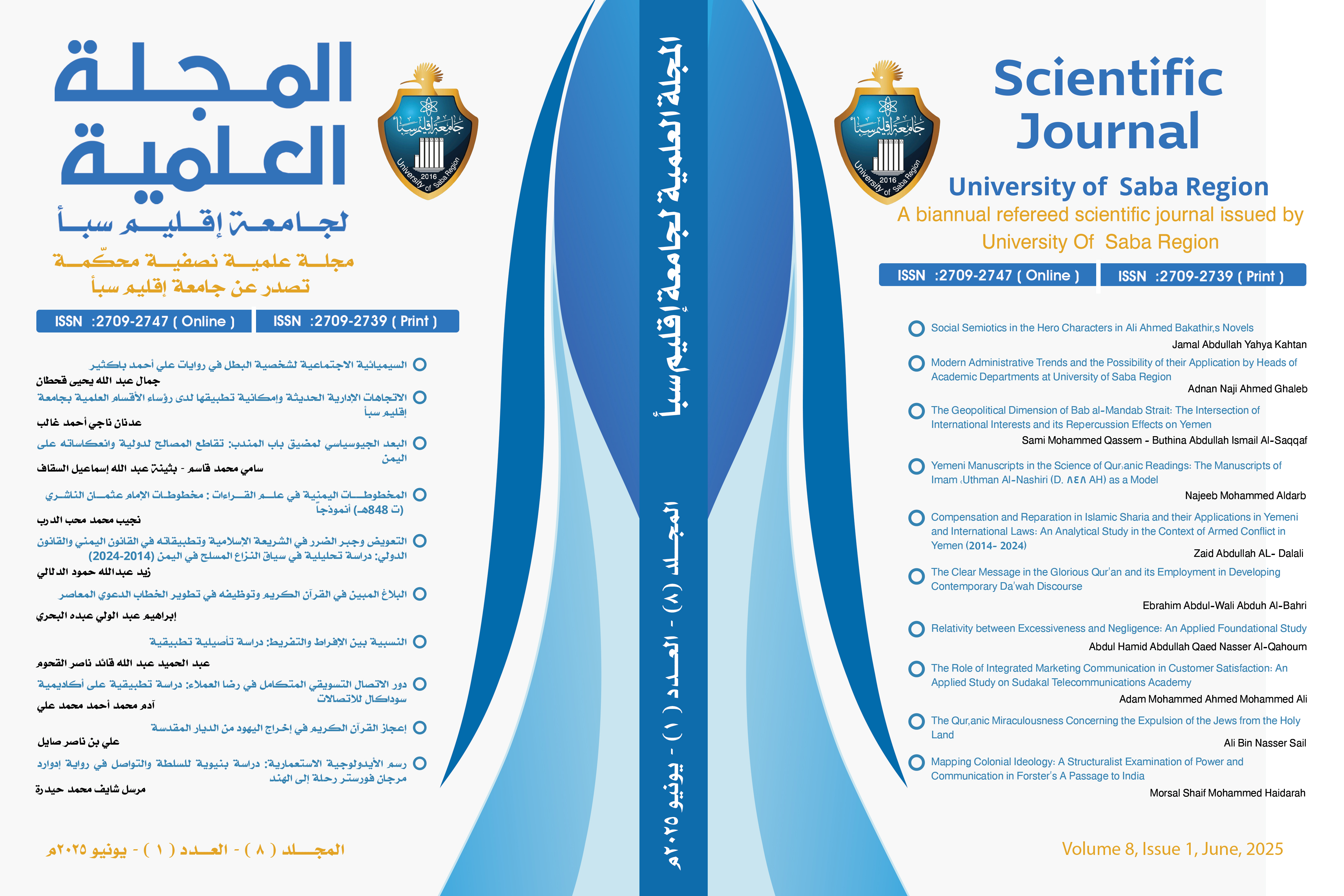
The Role of Integrated Marketing Communication in Customer Satisfaction: An Applied Study on Sudakal Telecommunications Academy
DOI:
https://doi.org/10.54582/TSJ.2.2.116Keywords:
Integrated Marketing Communication, Customer Satisfaction, Advertisement, Personal Selling, Public Relations, Sales Activation, Sudakal AcademyAbstract
This study is entitled “The impact of Marketing Communication on customer satisfaction”, applied on Sudakal Academy. The research problem is represented in the following question: Does marketing communications have an impact on customer satisfaction? The objective of the study is to identify the impact that marketing communications have on customer satisfaction. The main hypothesis of the study is as follows: there is a statistically significant relationship between marketing communications and customer satisfaction. There are also sub-hypotheses that are derived from the main hypothesis: there is a statistically significant relationship between advertising and customer satisfaction, there is a statistically significant relationship between personal sales and customer satisfaction, there is a statistically significant relationship between public relations and customer satisfaction, there is a statistically significant relationship between sales activation and customer satisfaction. The study arrived at several important findings: first, advertising at Sudakal affects the mental image of customers; second, employees at Sudakal training centers have information about training services; third, sales representatives of training centers respond to all incoming calls by phone; fourth, training centers provide clear marketing contact information, which enhances their mental image. The study recommends that Sudakal should focus on targeted advertising, establish a marketing department within the administrative structure of the training centers, establish a public relations department at the Centers, and increase the transmission of messages via the internet to reach as many customers as possible.
Downloads
Published
How to Cite
Issue
Section
License
Copyright and Licensing
This journal publishes all scientific materials under the Creative Commons Attribution 4.0 International (CC BY 4.0) , license, which grants you the following permissions:
You are free to:
- Share — copy and redistribute the material in any medium or format for any purpose, even commercially.
- Adapt — remix, transform, and build upon the material for any purpose, even commercially.
- The licensor cannot revoke these freedoms as long as you follow the license terms.
Under the following terms:
- Attribution — You must give appropriate credit , provide a link to the license, and indicate if changes were made . You may do so in any reasonable manner, but not in any way that suggests the licensor endorses you or your use.
- No additional restrictions — You may not apply legal terms or technological measures that legally restrict others from doing anything the license permits.
Notices:
You do not have to comply with the license for elements of the material in the public domain or where your use is permitted by an applicable exception or limitation .
No warranties are given. The license may not give you all of the permissions necessary for your intended use. For example, other rights such as publicity, privacy, or moral rights may limit how you use the material.